Trade effluent application guidance

You will need to apply for trade effluent consent through your retailer. If you are unsure who your retailer is, please check your most recent water bill.

  • Contents

    Retailer details

    This section can be completed by either the Retailer or non-household customer (NHH).

    As a minimum, the Retailer name, Retailer ID and Retailer's own reference must be completed and correct.


    Type of application


    Type of application

    (a) New consent 

    For new discharges expected to commence within the next six months, where no Consent currently exists. This includes a new discharge location at a consented premises or the change of ownership of site transferred to a new company.  

    For any new discharge expected to commence in more than six months, please contact us at trade.effluent@wessexwater.co.uk.  

    (b) New temporary consent 

    For temporary consents with a maximum duration of 6 months and temporary agreements (groundwater removal or flushing). 

    (c) Renewal after discontinuation 

    When a consent has been discontinued and the NHH/retailer is applying to restart the discharge. Wessex Water does not approve discontinuation applications. 

    (d) Variation to an existing consent 

    Where a Consent already exists but there is a change required to the existing conditions, or numerical limits (discharge standards, volumes, flow rates). 

    (e) Discontinuation of Trade Effluent Services 

    When the NHH customer requires a ‘suspension’ of the current consent. Wessex Water does not approve discontinuation applications. 

    (f) Termination of consent 

    Where the Consented discharge has permanently ceased.

    If boxes D or F are selected, we require the existing trade effluent consent reference to be provided


    Consent/DPIP/SPID Information

    A sewerage Supply Point Identifier (SPID) must be in place prior to progressing the application, unless it is a temporary consent where we will generate a temporary sewerage-only SPID.

    If the premises are not yet operational, a SPID may not be available. We would only issue the Consent once the SPID has become active (usually 8 business days before use). In all other cases, the correct (SPID) must be provided on the application. This can either be found on your latest sewerage bill or through your Retailer.


    Details of applicant to which application relates


    3.1 Information about the organisation applying for the consent to discharge

    We must ensure that a Consent is issued to the correct legal entity. Incomplete or incorrect information will result in the application being rejected.


    3.2 Registered address and other details

    If the applicant is a registered company, this must be the address registered with Companies House associated with the company registration number provided. If the applicant is not a registered company, this may be a private address of the premises or ‘head office’.

    Failing to provide complete and accurate information here will result in the application being rejected.

    In order to issue the Consent electronically, we ask that you provide the email address of the Company Secretary and/or a statutory Director, as per the companies register on Companies House. Please add this in the ‘More Information’ section at the end of the form.


    3.3 Trade premises details to which application for consent applies

    As a minimum, we require the full postal address of the premises and the name, e-mail address and telephone number for the primary contact at the premises, or the application will be rejected. 


    3.4 Operational information

    Operational hours for the premises and out-of-hours contacts are extremely important in case of incidents and emergencies.


    Section 4. Variation information


    A variation is required when the conditions in the existing consent need to be amended.

    This could include the following:

    • Increase or decrease in discharge volumes.
    • New production line or process.
    • New chemicals in use.
    • Other reasons affecting effluent quality.

    The details of the variation should include:

    • Details of flow volumes.
    • Details of any new substances or increase/decrease to consented levels.
    • Other details to support the variation request.


    Section 5. Trade effluent discharge description


    5.1 Production of Trade Effluent

    Describe in as much detail as possible the actual process producing the trade effluent. For example: ‘washing of vessels used to mix product’ or ‘washing of vegetables prior to processing’.


    5.2 Trade Effluent Treatment

    Provide as much detail as you can of any treatment that the trade effluent receives before being discharged to sewer, e.g. screening, fat trap, oil interceptor, biological treatment plant, pH adjustment, Reverse Osmosis, flow balancing, Dissolved Air Flotation (DAF), etc.

    Where available, provide supporting documentation for each treatment system, such as product specifications, performance data, drawing and schematics. Include a summary of the maintenance regime.
    If there is no treatment, state none.

    Dependent on the type of treatment and detail provided, we may request for further information.

    Where any of these boxes are blank, the application will be rejected.


    5.3 Chemicals/substances to be discharged or stored on site (with the potential to be discharged into the public sewer)

    All the fields must be completed.

    As a minimum, provide the expected discharge levels for all of the following parameters:

    • Chemical Oxygen Demand (COD), maximum
    • pH maximum and minimum
    • Suspended Solids (SS) maximum
    • Temperature (maximum must be less than 43°C)

    We expect you to provide reasoning for these levels. We need this information to ensure we set appropriate limits in the Consent to protect our assets, staff, and the environment.

    Following review of your application, we may request further information dependent on nature of the trade process (e.g. ammonia, chloride, phosphorus, metals, cyanide, etc.).

    For future or new discharges where sample results are not yet available, your retailer can assist you in determining the expected composition. Wessex Water may arrange for a series of samples to help support the application process if required.

    Provide details and material safety data sheets (MSDS) for all substances, compounds, and materials that are likely to be present in the Trade Effluent discharge. If none, state none. If left blank the application will be rejected.


    5.4 Volume of trade effluent

    You must provide details of the maximum quantity to be discharged (m3/day), and maximum instantaneous flow rate (litres/second), otherwise the application will be rejected 

    Please describe how volumes and flow rates of trade effluent discharged will be measured.

    Proposed Starting Date for Discharge

    Wessex Water will consider applications for discharges proposed to start within the six months following the date of application.

    For any discharge planned to commence more than six months from your application date, please contact us at trade.effluent@wessexwater.co.uk.

    Trade effluent monitoring and location


    6.1 Sample point location

    Under Section 121 of the Water Industry Act (1991), you are required to provide and maintain an inspection chamber or manhole to allow for a sample of the discharge to be taken at any time. Safe access to this sample point needs to be provided at all times and failing to do so may lead to enforcement action.

    Please provide sufficient details about the proposed sampling point. This must include trade effluent only (i.e. without contamination from toilets, kitchens, etc.).

    If you carry out any monitoring of your TE discharge, please state the parameters tested, the frequency of testing/recording, and details of any monitors.

    Failure to provide sufficient information about the sample point will result in rejection of the application.


    6.2 Drainage plan

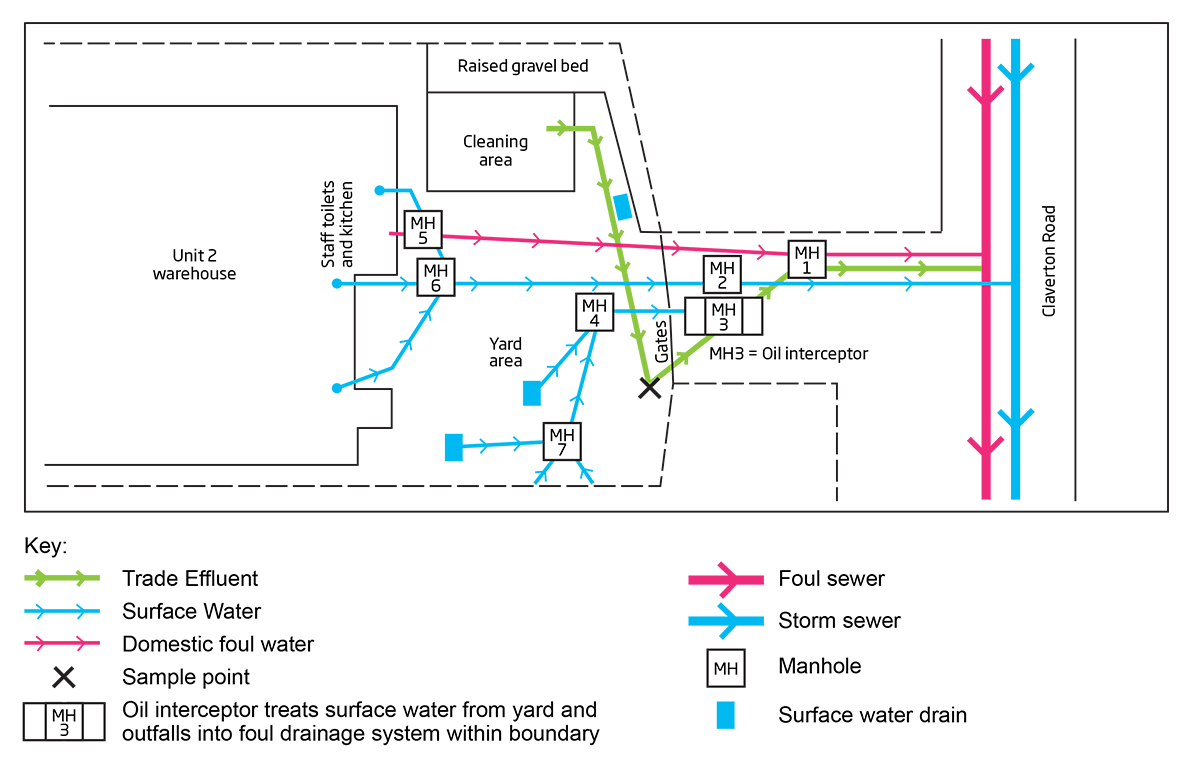
    Please provide a clear, legible plan using the correct colour coding that unambiguously identifies the following:

    • The exact location of the connection point where the TE discharge enters the public sewer.
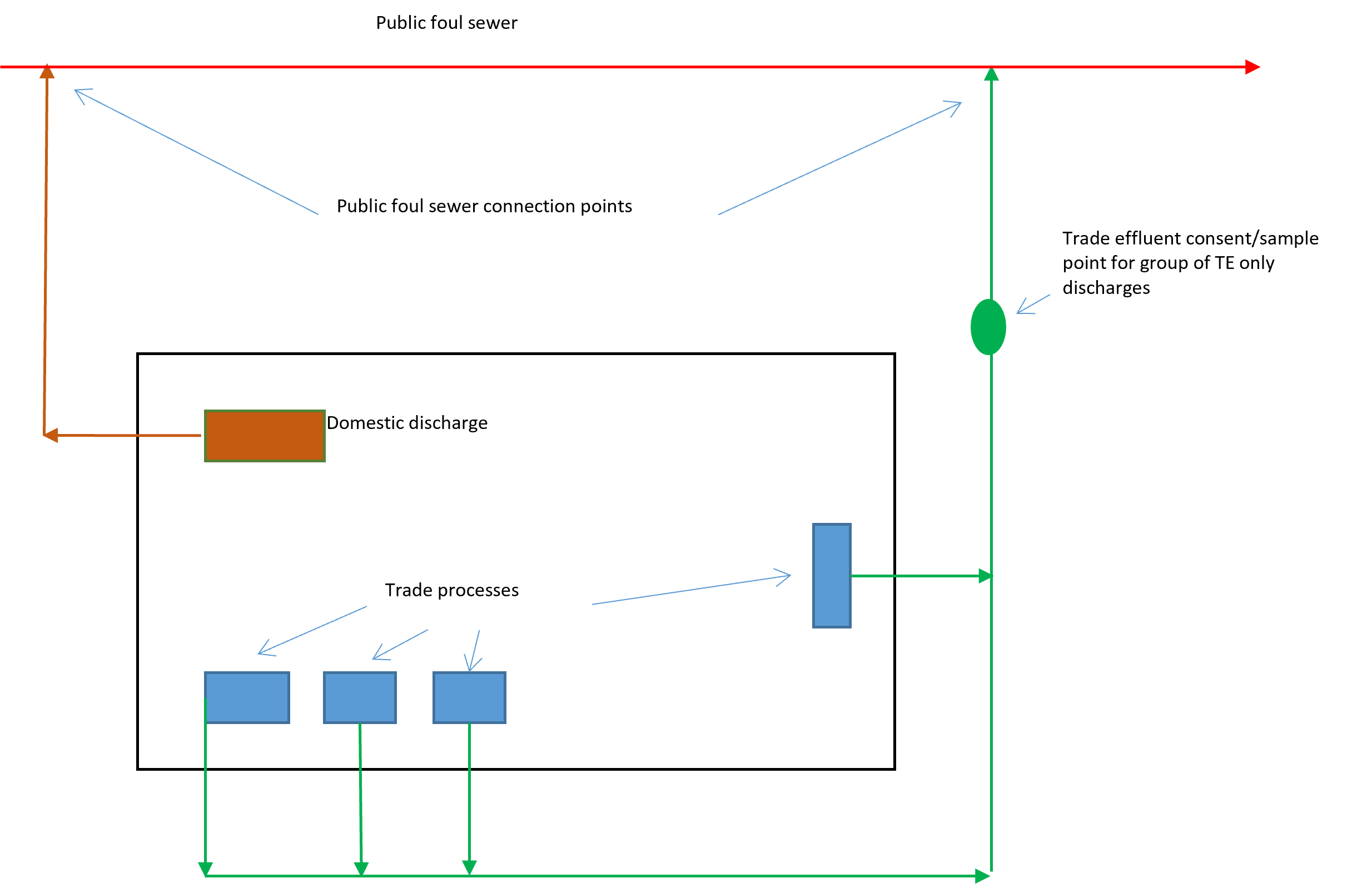
    • Location of TE sampling point, showing all flows that pass through it – See Appendix 2 for example.
    • The TE discharge route to the public foul sewer, including any private pipelines or sewers.
    • The street name at the location of the sewer into which the TE discharges
    • The location of any other discharges from site (for instance, domestic sewage or surface water),
    • The outline of any contaminated or uncontaminated areas, and their relevant drainage and discharge points,
    • Location of any TE treatment.

    If there is more than one TE discharge point from the premises, ensure the information above for each one is provided and clearly distinguished.

    Failing to provide sufficient, clear information will result in the application being rejected.

    Provide plans drawn to scale if possible.


    Please confirm whether any surface water (rainfall) flows through the sample point. If surface water from the site contributes to the trade effluent volume at the designated sample point, provide specific details.

    Surface water that may have become contaminated, such as run off from products or equipment stored in yards, may be considered trade effluent and included in your Consent.

    Uncontaminated surface water, such as run off from roofs or clean areas of hardstanding, is not classed as trade effluent. It therefore should not be mixed with trade effluent or foul sewerage. Application for new trade effluent discharges containing uncontaminated rainwater will be rejected.

    Any contaminated and uncontaminated surface water drainage areas must be shown on the drainage plan. 
    We may reject the application if the information provided in this section is missing or insufficient for us to process the application further.

    Volume assessment


    If water is received from a private network supplier, please supply all meter details as requested, and provide a photograph of the meter, showing both the serial number and meter reading.

    Accurate meter information is required to ensure that the correct meter is uploaded to the market and appropriate volumes calculated.  

    If there is a flow meter measuring the trade effluent discharged, provide all details requested and include calibration certificates and photographs.

    We must be satisfied that any TE flow meter used is adequate for accurately measuring and recording the volume and rate of the TE discharge only. TE flow meters should be certified to the MCERTS standard.

    We usually require a dedicated trade effluent flow meter for any consented TE discharges greater than 30m3 per day. Where one does not exist, we may include a Consent condition to provide one.

    Please provide approximate dates for any seasonal variation.  If insufficient detail is provided, we will request this information.


    Allowances

    We need to know the volume of water used for trade purposes which is not returned to the sewer. This needs to be supported with evidence.  

    Allowances on trade effluent charges may be applied for any water that is not returned to sewer (e.g. water into product, evaporative losses etc.). In order for these allowances to be given, they must be declared on the form, and sufficient evidence provided. You can submit a separate sheet if you do not have enough room on the form.

    For example, volume lost could be water going in the product for the manufacture of drinks, steam used in the process, liquid wastes or sludges tankered away. Please provide as much information on this as possible.

    Where there is no dedicated TE flow meter, you must provide sufficient information in sections 6.5 and 6.6 (rainwater and surface drainage), 6 (Water Supply Details), 7.2 (Site Consumption Information) and 8 (Allowances) to provide a full explanation how TE flows are to be measured. This is essential to monitor compliance with any flow limits included in a TE Consent, and ensuring that wholesale charges are calculated correctly. Please provide a water balance based on evidenced measured water consumption data, process or evaporation losses, expected domestic sewage volumes, tankering, etc. A schematic or tabulated water balance calculation should be provided if possible. 

    For more information refer to:

    Code Subsidiary Document No. 0206 - Trade Effluent Processes

    MOSL Market Codes

    Information relating to health and safety

    Please advise of any specific health and safety requirements for the site. If there are none, state none.

    Where a trader has been issued with an Environmental Permit, please submit a copy with the application.

    We may request additional information or clarification if we consider insufficient information has been provided in this section.


    Termination of trade effluent consent

    For termination, you must enter the date that the discharge ceased or where termination is proposed and provide the consent reference number in Section 2. Type of application

    Discontinuation of trade effluent consent

    Wessex Water does not allow discontinuation of a trade effluent consent. 


    Declaration of authorised signatory

    The application process will not proceed unless this section has been fully completed.

    This is to be signed by the non-household customers representative. A signed letter of authorisation (LOA) must be provided if a consultant or other identified authorised person is completing the forms and sign the declaration on behalf of the non-household customer.


    Appendix 1

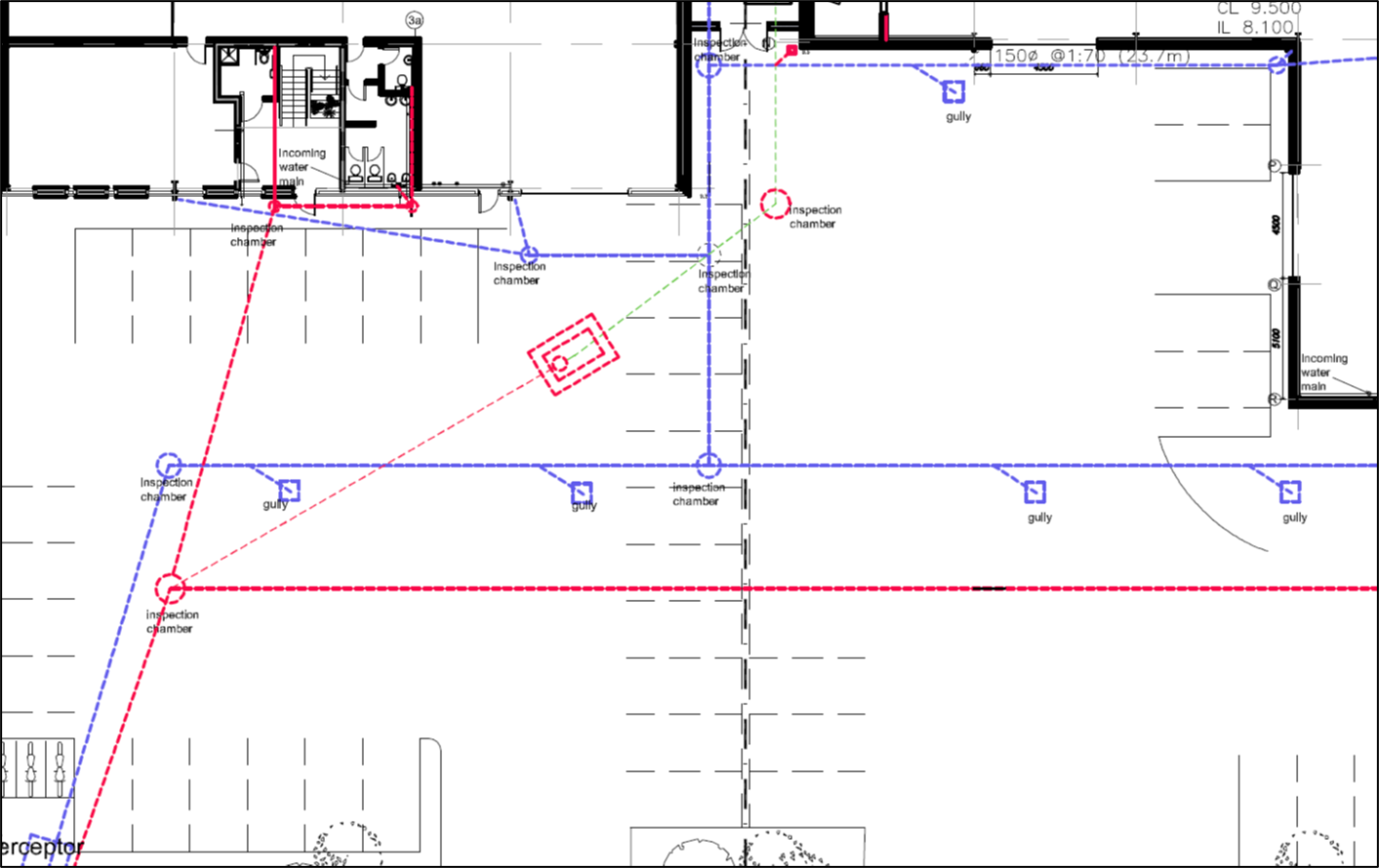
    Illustrative examples of acceptable and unacceptable plans for use with application form when applying for a trade effluent consent or variation to an existing consent.


    Example 1. A sufficient plan.


    Example 2. A detailed plan.


    Example 3. A detailed, but unclear plan.


    Appendix 2

    Illustrative example of acceptable location for TE sampling point

    More information on Trade Effluent